
Bobby Seale: Organizing Power and the Work of Building Community

Bobby Seale was born in 1936 in Liberty, Texas, and grew up moving across the country before eventually settling in Oakland, California. Like many Black families, his family migrated west in search of opportunity and safety, only to find new forms of racism waiting for them. Oakland in the mid-20th century was shaped by segregation, job discrimination, and aggressive policing — conditions that deeply affected Black communities and helped shape Seale’s political awakening.
Bobby Seale did not begin his journey as a famous activist. He was a working-class Black man, a carpenter, and a student trying to make sense of why Black people worked hard yet remained trapped in poverty. His political awareness grew through lived experience, conversations, and study. Seale believed that if Black people were going to challenge injustice, they needed to understand the system they were up against — not just emotionally, but intellectually.
While attending Merritt College in Oakland, Seale met Huey P. Newton. The two quickly recognized a shared understanding: Black communities were facing daily violence from police and systematic neglect from the government, and traditional appeals for change were not enough. Together, they studied law, history, and revolutionary theory, grounding their ideas in the real needs of their community.
In 1966, Bobby Seale and Huey P. Newton co-founded the Black Panther Party for Self-Defense. Seale served as the Party’s Chairman, while Newton was Minister of Defense. Seale’s role was critical. He focused on organization, structure, and political education. He helped turn radical ideas into clear demands and coordinated action.
One of Seale’s most lasting contributions was co-authoring the Ten-Point Program, a platform that outlined what Black communities were demanding from the United States government. The program called for freedom, full employment, decent housing, quality education, an end to police brutality, and exemption from military service that forced Black men to fight wars for a country that denied them basic rights. These were not abstract ideals — they were reflections of daily Black life.
Seale believed strongly in discipline and accountability. The Panthers were expected to study, serve the community, and represent the Party with purpose. This focus on organization helped the Panthers grow rapidly across the country, expanding into cities far beyond Oakland.
While the Panthers are often remembered for their armed patrols, Bobby Seale consistently emphasized that community survival programs were the heart of the movement. Under Panther leadership, free breakfast programs, health clinics, food distribution, and political education classes spread across Black neighborhoods. These programs fed children, treated illness, and built collective care where the government had failed.

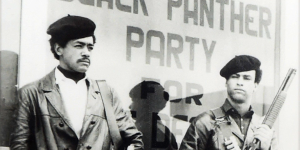

Because of this work, Seale and the Panthers became targets of intense government repression. The FBI labeled the Party a threat to national security and launched surveillance and disruption campaigns. Seale was arrested multiple times, often on questionable charges. The most infamous case occurred in 1968, when Seale was tried as part of the “Chicago Eight.”
During that trial, Seale was denied his constitutional right to legal counsel. When he protested, the judge ordered him to be bound, gagged, and chained in the courtroom — a moment that shocked the world and revealed the lengths the system would go to silence Black resistance. For many Black people, this moment confirmed what they already knew: the law did not protect Black freedom fighters; it protected power.
After his release from prison, Seale continued organizing and later ran for mayor of Oakland in 1973. His campaign emphasized housing, education, and community control, showing that revolutionary ideals could also shape local politics. Though he did not win, his campaign demonstrated the growing political influence of Black radical organizing.
Like many movement leaders, Bobby Seale’s life included contradictions and challenges. He faced personal struggles and political conflict, but his commitment to Black self-determination never disappeared. In later years, he wrote books, lectured, and continued to educate younger generations about the true history of the Black Panther Party.
For Black communities, Bobby Seale represents the often-overlooked labor of organizing — the meetings, the planning, the studying, and the care work that make movements possible. He reminds us that revolution is not only about bold moments but about sustained commitment to people.
Remembering Bobby Seale truthfully means recognizing him not just as a co-founder, but as a builder of systems, a defender of community dignity, and a Black man who believed that liberation required both vision and structure.

